Yannick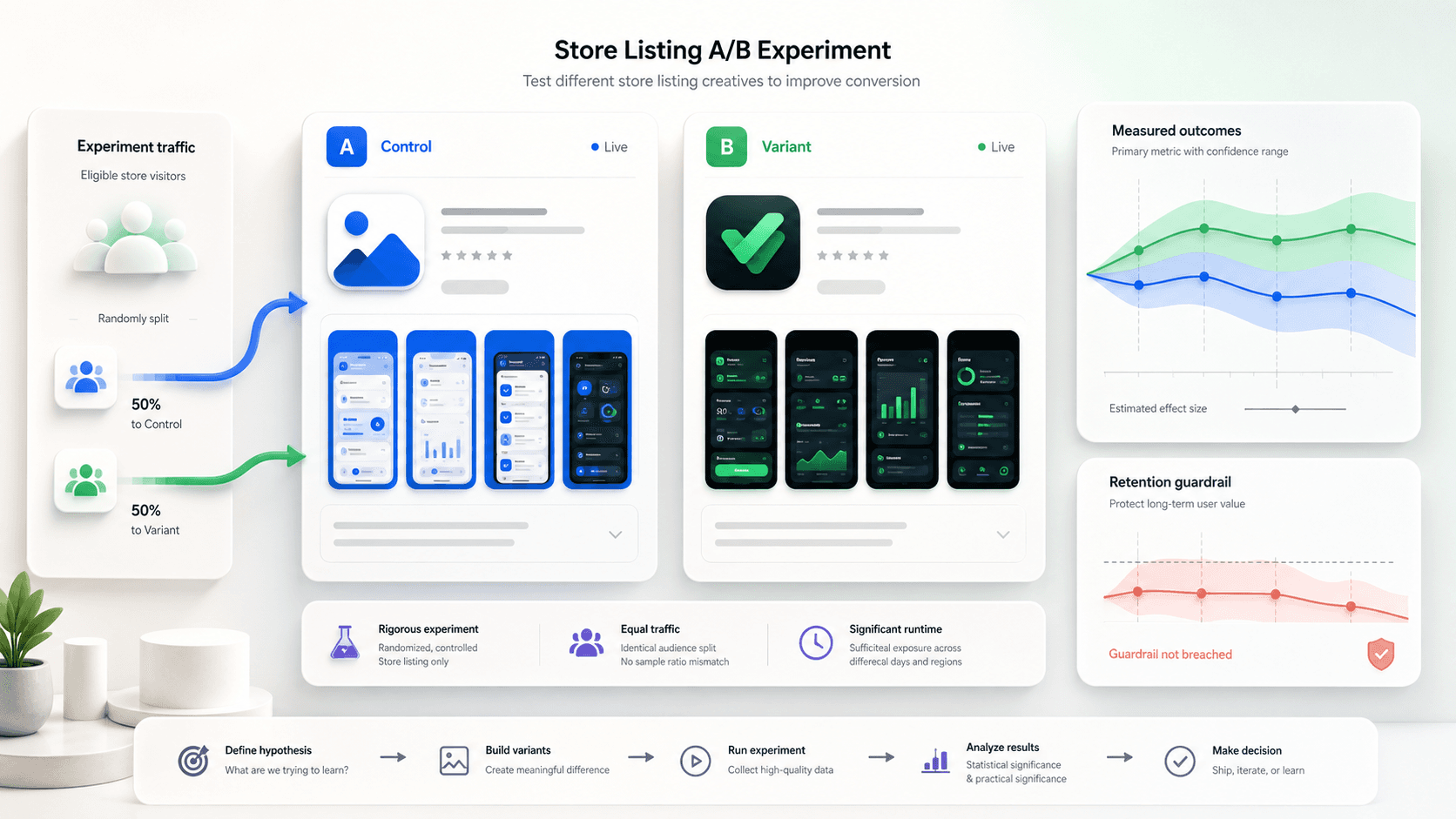
Change one decision at a time
A useful A/B test begins before Play Console
Choose one conversion hypothesis, create a meaningfully different variant, protect the traffic split, and judge the result with uncertainty and downstream quality in view.
Hypothesize
Name the audience problem, proposed change, expected behavior, and decision threshold.
Isolate
Test one asset family or one coherent story without unrelated listing and campaign changes.
Decide
Read the reported range, acquisition result, retention signal, and practical cost before applying.
Google Play Store Listing Experiments are free Play Console A/B tests for listing text and graphics. Google recommends using them to improve install conversion and retention, especially for icons, videos, and screenshots. The tool provides randomized evidence, but it cannot rescue a vague hypothesis, insufficient traffic, overlapping release changes, or a winner selected only because one point estimate is larger.
Quick answer
Test one high-impact question at a time. Keep the control unchanged, create a variant with a clear reason to win, choose the applicable audience and traffic allocation, and run long enough to include at least a full weekday/weekend cycle—Google recommends at least one week. Read the confidence interval or reported result rather than only the observed uplift, check 1-day retention and downstream activation, then apply, retest, or stop according to the decision rule written before launch.
What Google Play experiments can answer
Store Listing Experiments compare a control listing with one or more variants for eligible Google Play traffic. Google presents the feature as a way to test localized text and graphics and reports acquisition and 1-day retention outcomes. It is appropriate for questions such as whether a clearer icon, different screenshot story, revised short description, or stronger video improves conversion for the selected audience.
The experiment estimates what happened to the traffic included in that test. It does not prove that the result applies to every country, language, acquisition source, season, or future product version. Nor does it explain why a variant won. The explanation remains a hypothesis that can guide the next test, user research, or qualitative review.
| Element | Best question | Good variant | Main risk |
|---|---|---|---|
| Icon | Does the product become recognizable at search-result size? | One distinct symbol or contrast strategy | Changing brand recognition and style simultaneously |
| First screenshots | Does the listing prove the primary job sooner? | A reordered story with one new opening promise | Replacing every screen and losing attribution |
| Feature graphic | Does the promotional surface communicate the category and value? | One new hierarchy or campaign concept | Judging only the full-size canvas |
| Preview video | Does motion make the workflow clearer? | A different opening and product demonstration | Too many production changes in one edit |
| Short description | Is the outcome understood more quickly? | One positioning hypothesis in natural language | Keyword stuffing or a promise the app cannot fulfill |
Write the decision rule before making variants
A complete hypothesis identifies the audience, current friction, proposed creative change, expected metric movement, minimum useful effect, and action if the evidence is positive, neutral, or negative. For example: `For US English visitors, leading with the completed workout result instead of the setup screen will increase first-time acquirer conversion enough to justify replacing the first three screenshots, without reducing 1-day retention.`
The minimum useful effect is a business threshold, not a statistical setting. A tiny conversion increase might be real but not worth translating and maintaining across dozens of locales. Conversely, a modest result on a large, high-value listing may be commercially meaningful. Record the baseline window and practical threshold before seeing results to reduce the temptation to move the goalposts.
- Audience and locale included in the experiment.
- One primary metric and one product-quality guardrail.
- Minimum effect that justifies production and localization cost.
- Planned duration and events that would invalidate the readout.
- Apply, iterate, or stop rule for each possible outcome.
Choose control, variants, and traffic deliberately
The control should be the currently published, verified listing—not an outdated export reconstructed from memory. Make each variant meaningfully different enough to test the hypothesis while preserving everything else. If the hypothesis concerns story order, keep the visual style and copy system stable. If it concerns icon recognition, do not change the screenshots during the same experiment.
Traffic allocation creates a tradeoff between learning speed and exposure to an unproven variant. More variants divide traffic further and increase the sample needed to distinguish them. Small apps usually learn more from one control and one strong alternative than from several weak options. Save the exact control and variant assets with immutable IDs so the result can be audited after the listing changes.
Test icons, screenshots, and videos differently
An icon is evaluated at small size and often beside competitors. Review variants in real search-result context, on light and dark surfaces, and without assuming users have seen the brand before. A screenshot sequence is evaluated as a story: the opening frame, first visible captions, proof order, and continuity matter more than the beauty of any isolated frame.
Video introduces time. Test the first seconds, pacing, product visibility, captions, and poster frame as a connected experience. Google's general recommendation is to prioritize high-impact graphics such as icons, videos, and screenshots, but choose the element most likely to resolve the diagnosed friction. Do not spend a month testing a decorative footer while the first screenshot fails to state what the app does.
Duration, seasonality, and experiment hygiene
Google recommends running an experiment for at least one week so the result includes weekday and weekend behavior. A week is a minimum pattern check, not a universal sample-size guarantee. Low-traffic listings, smaller locales, subtle variants, or noisy acquisition sources may need longer. Avoid stopping the first time the preferred option moves ahead; repeated peeking makes chance fluctuations look persuasive.
Annotate product releases, featuring, paid-campaign changes, price changes, outages, ratings shocks, holidays, and competitor events. If one of these materially changes the included audience or conversion path, the cleanest decision may be to invalidate and rerun the test. Google also recommends revisiting assets because users, locations, and seasonality change over time.
Read uncertainty instead of worshipping the uplift number
Experiment interfaces summarize uncertainty with ranges, probabilities, or outcome labels. A displayed uplift is an estimate based on observed traffic, not a guaranteed future increase. If plausible values include both a meaningful loss and a meaningful gain, the result is inconclusive even when the point estimate is positive. Neutral evidence can mean the variants are genuinely similar or simply that the test lacked information.
Retain the control when the downside risk exceeds the practical upside, especially for high-volume markets. Apply a clear winner when the effect is useful and the downstream guardrail is acceptable. When evidence is neutral, decide whether a more distinct hypothesis is worth another test. Do not call the control a loser just because the new design was more expensive to produce.
Connect store conversion to product quality
Google's experiment surface includes acquisition and 1-day retention signals because a listing can win the install while attracting the wrong expectation. Add your own activation, trial, purchase, and retained-value checks where privacy-safe measurement permits. A screenshot promise that increases installs but produces immediate abandonment is not a durable conversion win.
Keep the experiment assignment and downstream analytics separated conceptually. Platform reports and product analytics may use different attribution windows, identities, and privacy thresholds. Use directional guardrails unless the systems are joined with a validated measurement design. Document definitions alongside the result so a later team does not compare unlike metrics.
Apply a winner and preserve the evidence
Before applying a positive result, confirm that the selected variant is still accurate for the current build and that its source files are ready for every required locale. Use managed publishing intentionally if the asset change must coordinate with a release or campaign. After publication, monitor normal listing and product metrics; experiment performance can regress when the audience mix or competitive environment changes.
Archive the hypothesis, dates, market, traffic allocation, exact assets, platform result, guardrails, confounders, and final decision. A compact experiment ledger prevents duplicate tests and creates a library of what the team has actually learned. Separate facts—what was randomized and observed—from interpretation—why the team believes the change worked.
- Publish the verified winning files, not a later hand-edited recreation.
- Localize only after checking that the hypothesis survives each language and market.
- Record neutral and negative tests; they reduce repeated waste.
- Schedule a follow-up review when the product, category, or season materially changes.
Continue the workflow
Primary sources and verification notes
Platform requirements and software capabilities change. These sources were reviewed for this guide on August 16, 2026; open the current source again before publishing assets, enabling production access, or standardizing a team workflow.
- Google Play Console: Store listing experiments: Official capabilities, reported metrics, and experiment best practices.
- Google Play Help: Growth overview: Current experiment usage and follow-up recommendations in Play Console.
- Google Play Help: Preview assets: Current requirements for tested icons, screenshots, feature graphics, and videos.
- Google Play Help: Managed publishing: How reviewed store-listing changes are coordinated for publication.
Google Play Store Listing Experiments FAQ
How long should a Google Play store listing experiment run?
Google recommends at least one week to include weekday and weekend behavior. Low traffic, subtle variants, or noisy audiences may require longer; do not stop solely because one option moves ahead early.
What should I test first on a Google Play listing?
Test the highest-impact element tied to a diagnosed problem. Google highlights icons, videos, and screenshots; for many apps, the icon or first screenshot story is a stronger starting point than decorative details.
Should I test several assets at once?
Usually no. Google recommends testing one asset at a time for clearer results. A coherent screenshot-sequence test can change several frames when the sequence itself is the single hypothesis.
Is a positive observed uplift automatically a winner?
No. Read the platform's uncertainty range or result label, compare it with your minimum useful effect, and check retention or downstream activation before applying the variant.